It stands to reason that if the raw materials we work with are of good quality and the processes are well managed, the end result will be as expected. In addition to looking at the functioning of the supply and production chain, it is also necessary to pay attention to the management of the suppliers we source from.
Proper supplier management can help us to better understand our needs and those of the companies that provide us with raw materials to manufacture our products.
Bien coordinado podrá ahorrar dinero al negocio y generar una mejor gestión de la cadena de suministro de forma generalizada. ¿Quieres saber cómo comenzar o cómo podemos ayudarte a ello desde MRO? ¡Te lo contamos!
.
What is a supplier?
Before starting to talk about supplier management, it is necessary to explain what a supplier is. They are part of the production chain of any company that works or sells products. In fact, they are in charge of supplying other companies with the goods or raw materials they need to be able to carry out their operations and continue with the business.
That is why the figure of the supplier is so important for a company, as is maintaining good relations with them. It is essential to know as much information as possible and to build mutual trust. Things can get a bit more complicated if the company is very large and talks to many suppliers at the same time. In such cases it is more difficult to obtain information from all of them, so they often turn to external companies to help them in supplier management.
At MRO we provide outsourced procurement, warehousing and value-added solutions and indirect materials to customers in the manufacturing, assembly and process industries, so if you don’t know where to start with your management, you can always count on our team.
.
What is supplier management?
If a supplier is the person or company that is responsible for supplying us with everything we need to carry out our “task”, supplier management is the way in which we relate to them. The aim of this department, as it is necessary for the company to have a number of employees in charge of suppliers, is to generate good relationships and to be able to manage them in a win-win way.
Keep in mind that, if there is a good relationship, the value of the company can be optimised by ensuring that quality standards are met. As well as improving the supply chain. To do this, we must always be honest with our suppliers and establish solid and real relationships in order to carry out strategic planning. Remember that you will also have to take stock control into account if you deal with suppliers, so we recommend you read this post.
In supplier management there are a number of indispensable tasks that always have to be performed:
- Select suppliers.
- Compare them.
- Ensure that all industry quality standards are met as well as those you demand as a company.
- Follow-up of the shipping processes (delivery times, transport costs…).
- Have regular supplier audits.
.
.
Is it the same as the supply chain?
Earlier we discussed the term “supply chain” when talking about supplier management, but is there a difference? The confusion lies in the fact that both processes are part of the same phase, but focus on different aspects.
Supplier management is dedicated to cultivating effective relationships with suppliers, while supply chain management focuses on the logistical processes that span the entire chain (from the flow of goods to optimising the flow of information and financial resources).
.
Benefits
Proper supplier management can help us in many more aspects of business than we realise, for example:
.
Increasing supply chain agility
By having a strategy in place, we will be able to improve responsiveness to unexpected market events and/or new business needs. It will also be possible to create emerging strategic alliances with a quick identification, qualification, incorporation and management of new suppliers.
.
Saving on costs
As we will be applying new forms of efficiency and productivity, even if it is not our main objective, we will be reducing costs by facilitating seamless connectivity and collaboration with suppliers.
.
Reducing supply chain risk
Greater control of supplier management will make it possible to anticipate and mitigate risks, even in times of crisis. Keep in mind that we will be eliminating blind spots in transactions and enabling visibility of multiple parties. Putting all cards on the table honestly and respectfully will minimise potential disputes between suppliers.
.
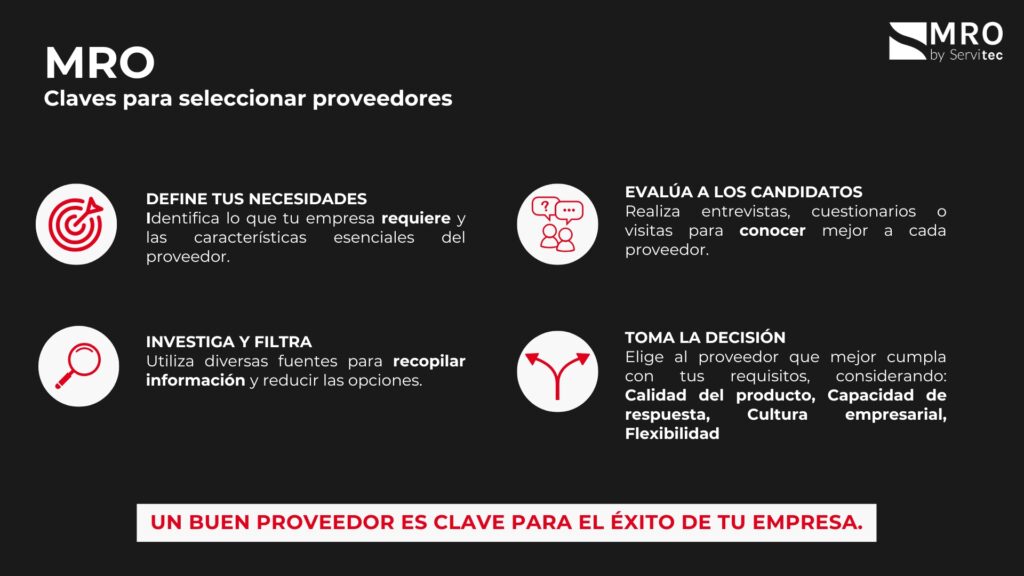
Keys to selecting suppliers
Selecting suppliers is a fundamental strategic task for any company, especially for those that buy many of the raw materials that are subsequently used in their production process. It is therefore important to be clear about some key points or data that will help us to select the best suppliers for our business and within our industry:
.
Defining needs
Before looking for a supplier, the company must be clear about the needs it wishes to cover and the non-negotiable characteristics that the supplier must have in order to satisfy them.
.
Do a search
It is best to use all means at your disposal, such as the Internet, trade fairs or referrals from other entrepreneurs, to gather information on available suppliers and make a first sift.
.
Evaluating suppliers
Once you have a list of suppliers to consider, it is time to evaluate them. This process is usually done through interviews, questionnaires sent to the suppliers themselves, site visits, reference research from previous customers and quality testing of products or services.
.
Selecting the right one
With all the information gathered in our hands it is time to make the final decision and choose the supplier that best suits our needs. It is necessary to focus not only on price, but also on factors such as product quality, responsiveness, company culture, flexibility and values.
.
.
What to consider in contracts with suppliers
When it is time to talk seriously, that is, when we have already chosen the suppliers we want to supply us and we are going to formalise a contract, is where supplier management comes into its own. They will be in charge of taking into account all aspects of the deal so that it benefits both parties and guarantees a successful and long-lasting business relationship.
That is why it is always important for the department to keep in mind some key points to always discuss before giving the final “yes”:
.
Establish the terms
The contract should specify the terms of the business relationship between the company and the supplier, including products or services to be purchased, prices, method of payment, duration of the contract, delivery conditions, etc.
.
Legal protection
Of course, if we want to formalise it definitively, we must generate a legally binding contract, which sets out the rights and obligations on both sides. In this way we ensure that, as a company, we are protected in the event of a breach of contractual obligations, and vice versa.
.
Contract management
It is not enough just to sign the contract: you have to make sure that it is managed in the right way: keeping track of delivery deadlines and complying with contractual obligations and any other clauses that have been agreed in advance.
.
Negotiation
Es importante negociar los términos del contrato para cerciorarse de que ambas partes estás sacando provecho. Tanto eres la empresa como el proveedor, por supuesto te querrás asegurar de que estás obteniendo los mejores precios y condiciones posibles. Recuerda, desde el departamento de gestión de proveedores, será imprescindible establecer incentivos y penalizaciones que fomenten el cumplimiento del contrato.
.
Object of the contract
It is necessary to detail the service that is being contracted or what the collaboration consists of, indicating what it includes and what it does not include.
.
Terms of delivery and payment
Everything to do with delivery deadlines, payment deadlines, payment terms, etc., i.e. delivery and payment, should be formalised and put in writing in the contract so that, if there is a problem later on, a legal document can be used to solve the problem.
.
Protection clauses
Last but not least, we recommend that you always include protective clauses to ensure that the supplier fulfils its contractual obligations (to establish penalties in case of non-compliance or guarantees of product or service quality).
Coordinated correctly and communicatively, supplier management can help us save money and be more efficient as a company. But it does involve considering the needs, objectives and cultures of both parties. That is why it is so important to find the right supplier, with whom we can share common goals. From this approach can come the competitive advantage, the ability to differentiate and the value needed to support the business proposition.
So if you don’t know how to manage this part of your business or need help, you can always contact the MRO team, where we will offer you services that streamline your supply management processes, improving the control and organisation of your spare parts. We also offer additional services to complement MRO solutions based on your company’s specific circumstances, so we work specifically to your needs.
.